Made-to-measure wooden walk-in wardrobes in Dénia
Before we talk about styles, you need to decide what your walk-in wardrobe is made of: which parts will be solid wood, which natural veneer, and which a decorative board that imitates it. That choice affects the feel, the cleaning, how the furniture ages and what it costs. If you are looking for made-to-measure wooden walk-in wardrobes in Dénia, here is a guide to materials so you can start your project knowing what to ask for and where it is worth letting the wood show.
Shape your next wardrobe.
Try out the measurements, plan the interior layout and choose your finishes. See your idea take shape and share it with us so we can prepare your quote.
Send us your configuration with your measurements and we'll give you a guide price within 24 hours, free of charge. The measuring visit at your home comes afterwards.
Deciding where you want visible wood
A made-to-measure wooden walk-in wardrobe is rarely made entirely of wood, and it doesn't need to be. The useful thing is to mark on the plan the surfaces that are seen and touched: drawer fronts, shelves at eye level, the hanging rail, the back panel. In a wooden walk-in wardrobe, that is where the wood makes its mark. Hidden sides, backs and internal frameworks, on the other hand, can be made in hard-wearing board without changing the final look. Marking three zones (what is seen, what is touched and what is hidden) helps you share out the budget sensibly and avoid paying for fine wood where nobody will be looking at it. That first split is what shapes the result more than anything.
Solid wood, natural veneer and decorative board
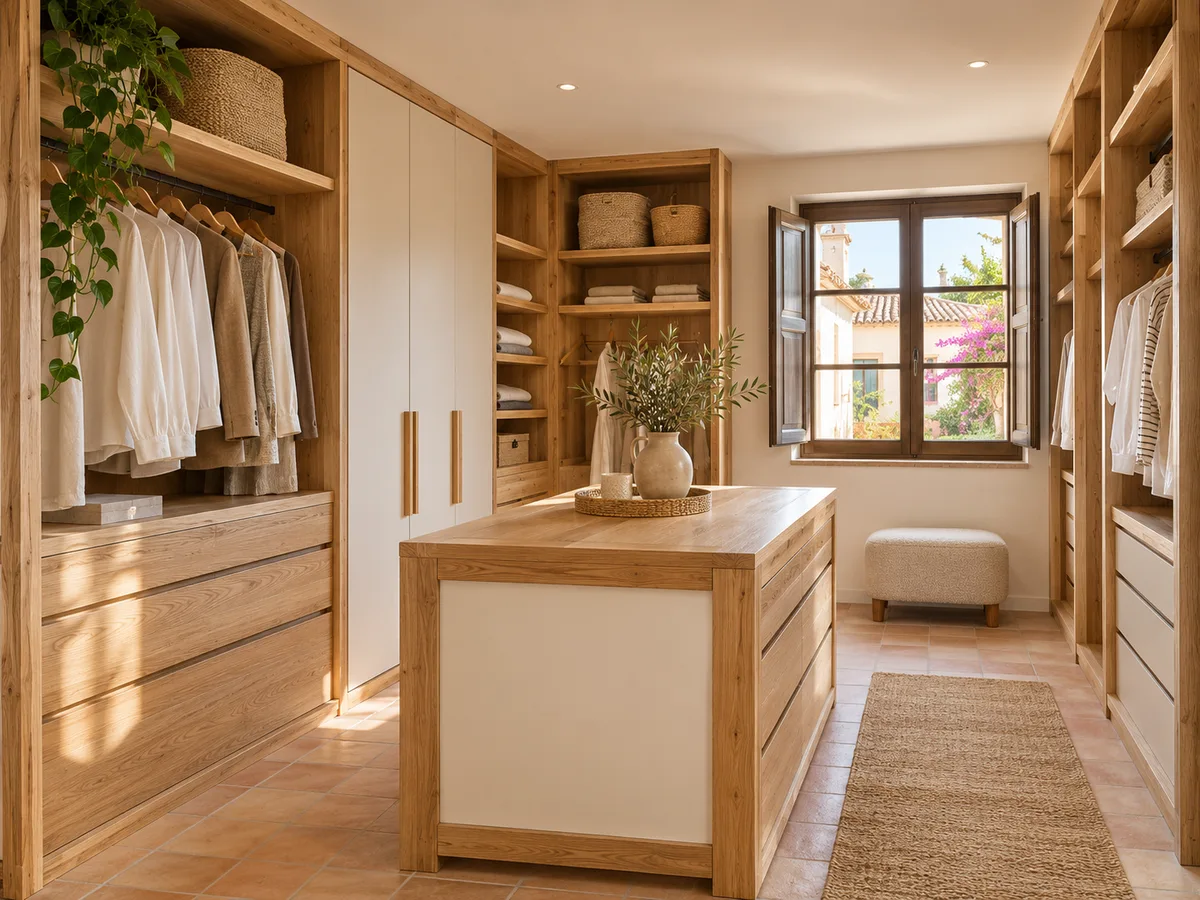
Solid wood is a whole piece of timber: noble and repairable, but sensitive to changes in humidity and more expensive, so it is kept for rails, visible shelves or finishing details. Natural veneer is a thin sheet of real wood bonded to a stable board; it gives you the authentic grain with better stability and is the usual choice for quality doors and fronts. Decorative board has a paper or melamine layer with a wood pattern; it stands up well to wear, is easy to clean and costs less, although the grain repeats. In a wooden walk-in wardrobe all three often sit side by side: solid wood where you touch it, veneer on the fronts and decorative board inside.
Materials for the carcass, fronts and accessories
A walk-in wardrobe is made up of three families of parts. The structure, meaning the sides, dividers and shelves, bears the weight and is usually made in board. The fronts, that is drawers and internal doors, are what you see and can be in veneered or solid wood. The accessories, such as hanging rails, trouser racks and shoe racks, can be wood, metal or a mix of both. Each family has different demands: long shelves need stiffness so they don't sag, fronts need stability so they don't warp, and rails need to withstand the weight of your clothes. Specifying the same material for everything is convenient, but it is not always the best choice.
Have you already measured the space?
Send us a photo and the approximate measurements on WhatsApp and we'll give you some initial guidance.
Tone, grain and physical sample
The names of woods give you a clue, but the sample decides. Oak can be pale and almost golden, or greyish and matt; walnut ranges from chocolate to reddish brown; ash is light with a pronounced grain. Within each species the tone changes with the batch, the cut and the finish, so a photo never fully reflects what will arrive. Choose with a physical sample in the light of the room, next to your flooring and joinery. The grain matters too: a straight grain looks calm on long fronts, while a livelier one adds character on small pieces. If the order is large, ask for grain continuity between neighbouring modules.
Combining wood with other surfaces
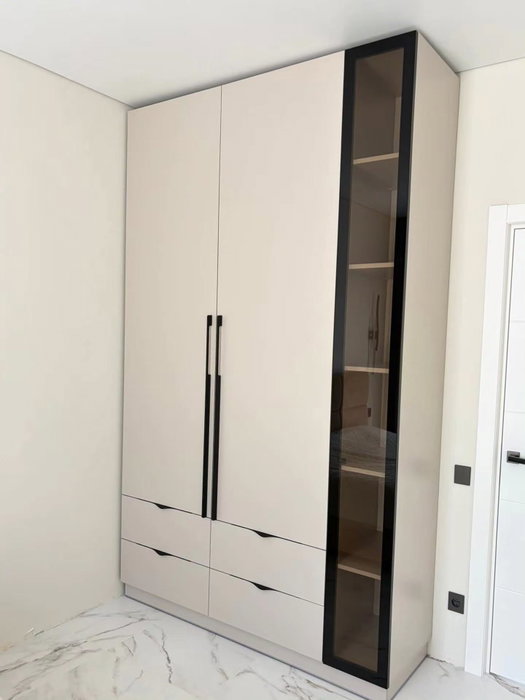
Few wooden walk-in wardrobes work well in 100% wood: it feels overwhelming and becomes dark. It works better to balance it with a plain material, such as a matt lacquer, a sand tone or a coloured back panel. The wood then shines where it matters and the rest gives the eye a rest. Metals help too, with black rails or aged brass, and glass or a mirror in one column makes the space feel larger. You need to decide whether the wood will be the star, the supporting act or a detail, and the proportion depends on that: one whole wall in veneer and the rest neutral, or a single wood module in the middle of a light scheme. It is worth sketching it out to see the balance.
Latest work by SI, ARMARIO
@si.armario
Made-to-measure wardrobes and walk-in wardrobes
Latest posts
Cleaning and performance by finish
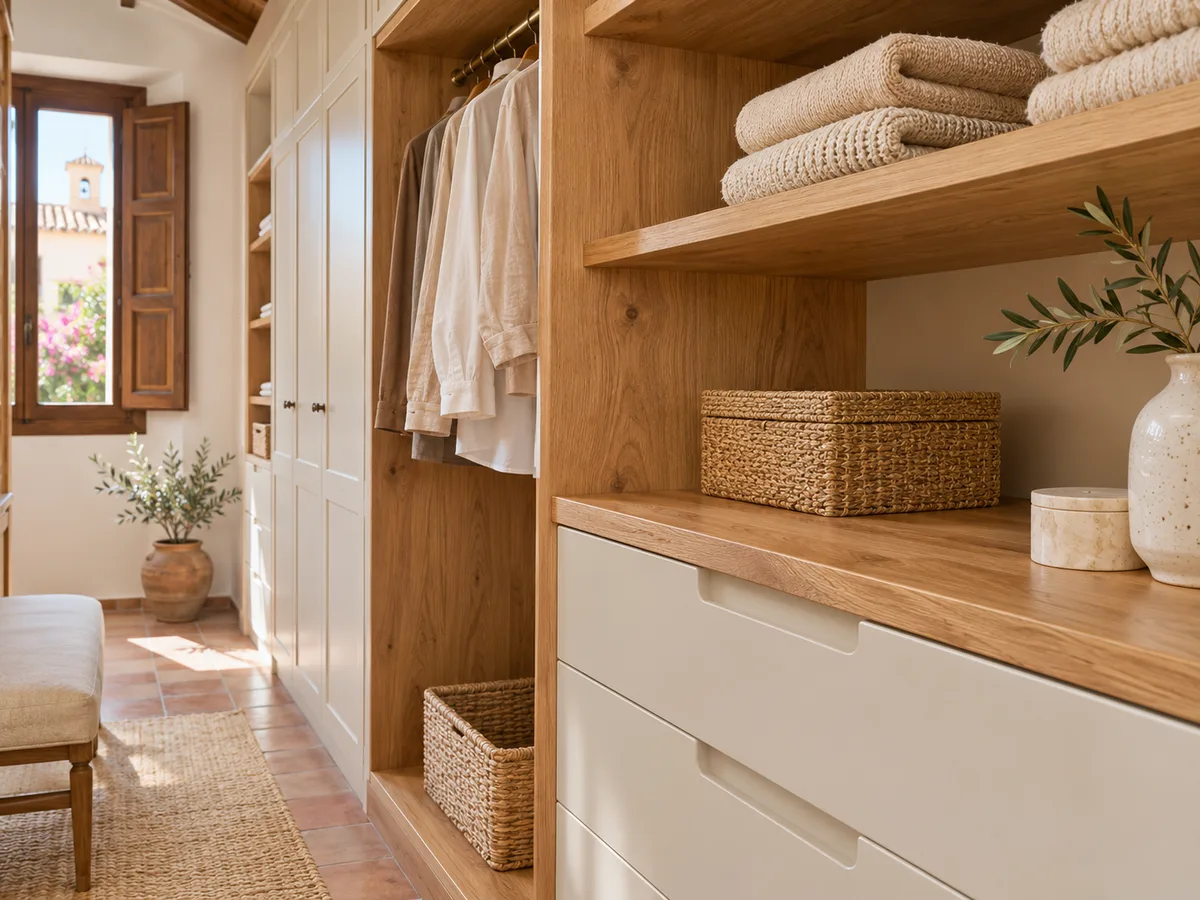
The finish matters as much as the wood. A varnish or natural oil keeps the feel of the fibre and is easy to touch up, but needs a little care. A matt lacquer seals the pores and is more resistant to stains, and a high-pressure finish on decorative board stands up well to zips and handbags rubbing against it. In areas with a lot of humidity in the air, such as those close to the sea in Dénia, it is best to avoid very wide solid pieces, which move with changes in humidity. For cleaning, a slightly damp cloth is enough and, on oiled pieces, a maintenance coat from time to time. What you shouldn't do is clean with abrasive products.
Ask us to come and measure up in Dénia
- 01You leave us your name and your area.
- 02We message you on WhatsApp to agree a day.
- 03The measuring visit costs €50 and is free if you place an order.
How the material affects the quote in Dénia
Without talking figures, the order is clear: decorative board is the most economical option, natural veneer sits in the middle and solid wood is the most demanding. On top of that come the thickness, the finish and the number of drawers with wooden fronts, which multiply the visible surfaces. Switching material on hidden parts frees up budget to invest in what is seen: good veneer on the fronts or a solid rail you can feel in your hand. That is why it is worth writing down which pieces are the priority before requesting the proposal, rather than asking for one wood for everything. Pricing guidelines are explained in the pricing section of the site.
Choosing a modern or rustic style
The same wood changes a great deal depending on how it is worked. A smooth oak with fine edges and no handles reads as contemporary; with a pronounced grain, a warm tone and framed doors, it comes closer to rustic. That is why the material is chosen before the style, and the style is achieved through the layout, the handles and the finish. If you are leaning towards clean lines, take a look at the page on modern wooden walk-in wardrobes; if you want texture and warmth, the one on rustic walk-in wardrobes. In both cases you start from the same material options you have seen here, just with different proportions and details.
How your order comes together
Go into the configurator, enter your measurements and mark which parts of the wooden walk-in wardrobe you want in natural veneer, solid wood or decorative board. A design is prepared and sent to us, and the team replies with an approximate price within 24 hours at most of receiving that configuration, at no cost. The measuring visit, €50 if you don't place an order and free of charge if you do, confirms the dimensions and lets you see the samples next to your flooring and joinery. After that, manufacture usually takes two to three weeks on average, and the installation is arranged separately. We take on made-to-measure wooden walk-in wardrobe projects in Dénia and the surrounding area, so you can send us your first ideas even if you haven't decided on the material yet.
Enquiry
Tell us about your project in Dénia
- 1We read your message and look at your photos.
- 2We reply on WhatsApp with a first figure.
- 3We measure up and prepare the final quote. The measuring visit costs €50 if you don't go ahead with the order and is free if you do.
We don't cut a single board until you've approved the design and the price.
Questions
Frequently asked questions about wardrobes in Dénia
After installation: warranty and care for your wardrobe.
Which parts of the walk-in wardrobe are worth making in real wood?
Any of them, although it is usual to concentrate it on the fronts, visible shelves and rails. The hidden structure is usually made in stable board, which adds rigidity and keeps the cost down without altering what you see.
How can you tell natural veneer from a simple wood effect?
Natural veneer has an irregular grain, with small differences between pieces, and a warm feel. The wood effect repeats the pattern and tends to feel more uniform. A sample in your hand makes it clear straight away.
Does the whole piece have to be in the same material?
No. Mixing is the norm: wood on the visible parts and decorative or plain board on the rest. What matters is that the tones of all the pieces line up with each other.
What do you sign off on the tone before manufacturing starts?
With physical samples viewed in the room and a design showing each finish. We confirm in writing which wood and which finish each piece will have.
Does solid wood warp with humidity?
It can move a little with changes in humidity, especially in wide pieces. That is why it is used for rails or narrow pieces, and veneer on board is kept for the large fronts.
Can an oak walk-in wardrobe have an interior in another colour?
Yes. An oak front with a white or grey interior brightens the space and makes your clothes stand out. It is settled with samples of both materials side by side.
Shall we talk about your project?
Send us a photo of the space and some approximate measurements on WhatsApp: we'll give you some initial guidance and arrange the measuring visit.