Made-to-measure corner wardrobes in Dénia
A corner often stays empty because hardly any off-the-shelf furniture fits it properly. A corner wardrobe, on the other hand, turns the angle between two walls into the deepest storage space in the room. If you are looking for made-to-measure corner wardrobes in Dénia, here you will see when an L-shaped layout makes sense, how to reach the back of the corner without losing centimetres, and what happens with nearby doors, windows and walkways.
Shape your next wardrobe.
Try out the measurements, plan the interior layout and choose your finishes. See your idea take shape and share it with us so we can prepare your quote.
Send us your configuration with your measurements and we'll give you a guide price within 24 hours, free of charge. The measuring visit at your home comes afterwards.
What you can gain from a corner wardrobe
The corner of a room is where the most cubic metres go to waste. A corner wardrobe recovers them: it spreads two fronts across two walls and makes use of the angle with a deeper module. In a three-by-three-metre bedroom, an L-shaped layout can add almost a metre more of hanging rail than two straight wardrobes of the same size.
It works just as well for a main bedroom with a dressing area, for a child's room where clothes and toys both need a home, or for a living room with a dead corner next to the terrace. What changes is the proportion of hanging clothes, shelves and drawers.
L-shaped wardrobe, corner module and continuous fronts
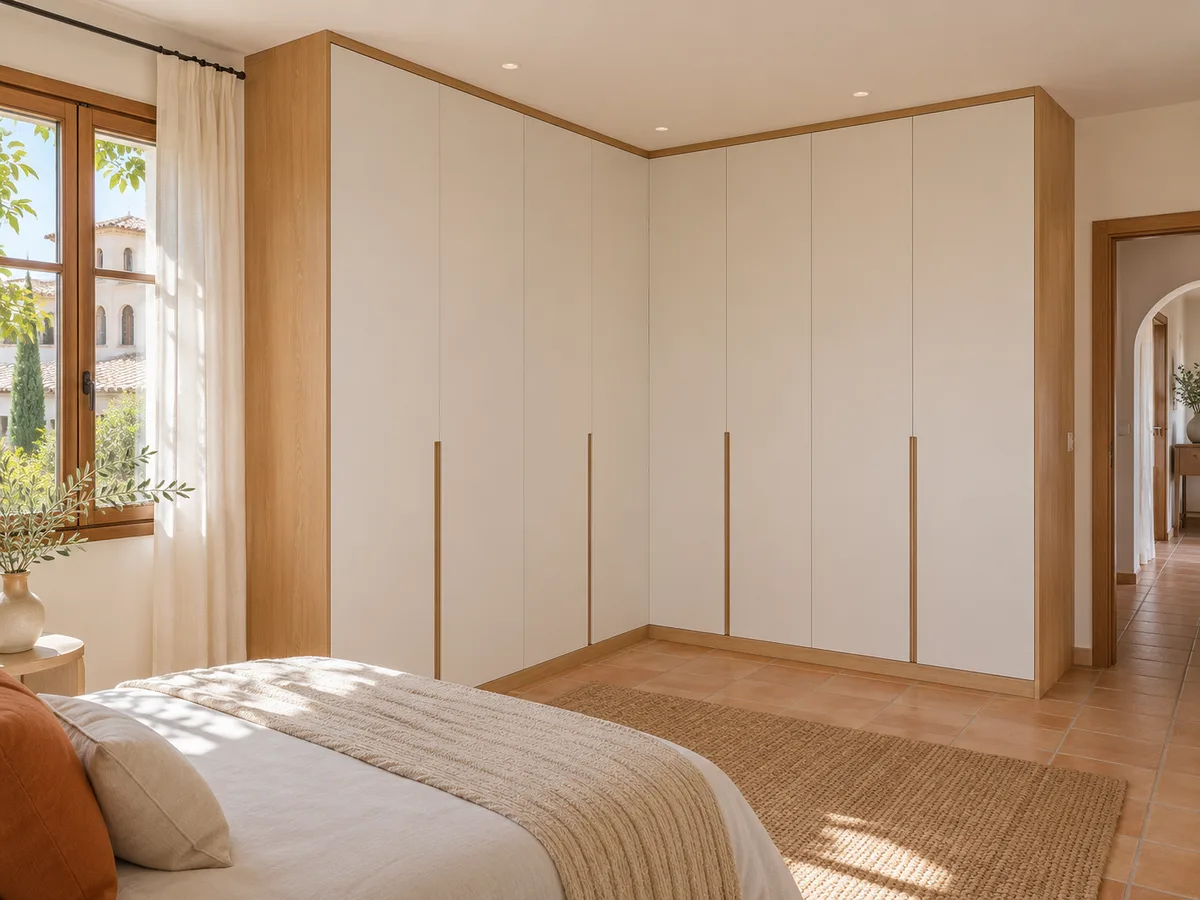
There are two ways to resolve the corner. In a single-body corner wardrobe, both sides are joined to form an L, with a shared depth in the corner and a continuous front. In the sectional solution, two straight wardrobes meet at the corner and a joining module, sometimes with a diagonal door, closes it off.
The single body looks cleaner and spreads the weight better; sections make transport simpler and allow you to change one part without touching the other. In homes with a narrow staircase, the second option is easier to carry up. Also consider whether you want the doors on both sides to meet at a right angle or the central module to be blind.
How to reach the back without creating dead zones
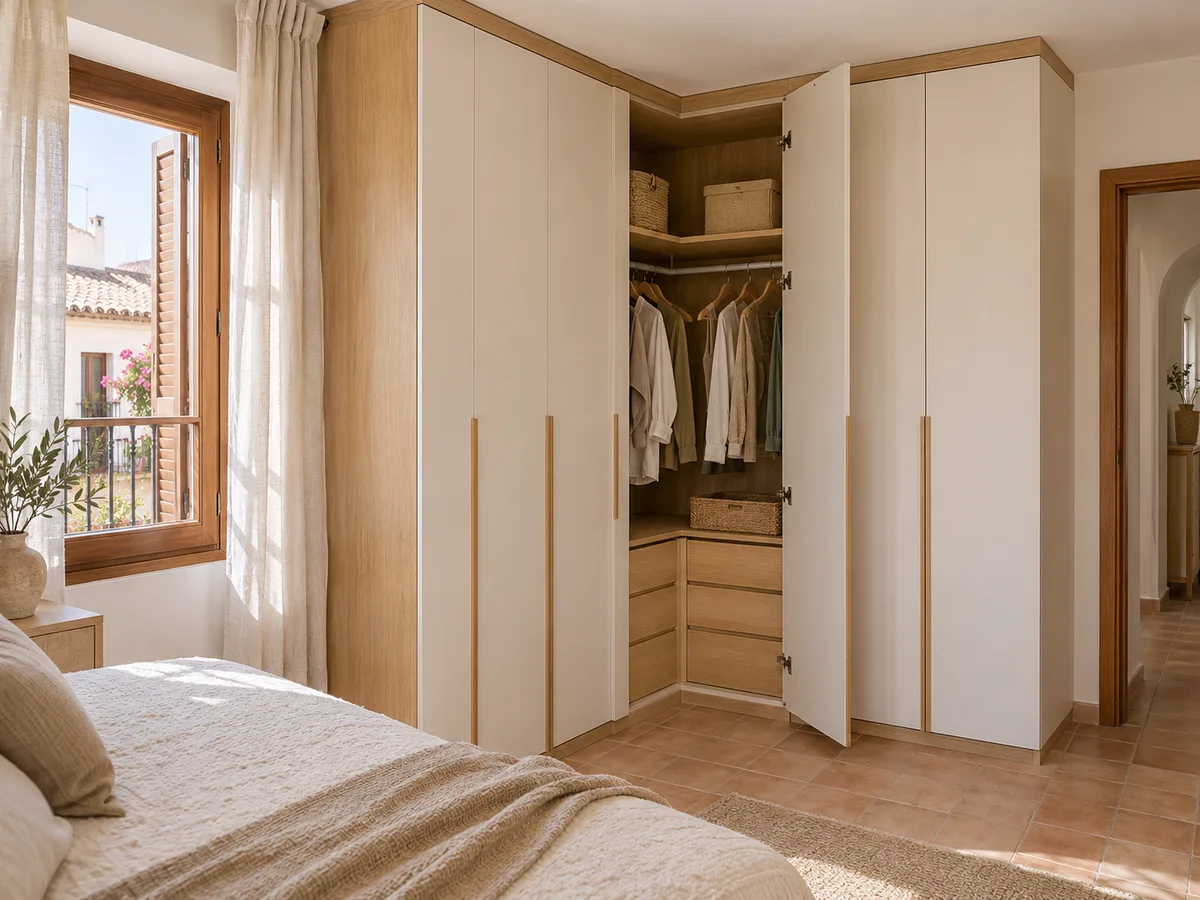
The big problem with a corner wardrobe is the deep space at the corner, which is hard to reach. There are several solutions: a revolving shelf or pull-out tray, a long rail that enters from one side, a door with a wide-angle hinge, or a diagonal module with its own door that gives direct access to the back.
You can also leave a blind corner of around 60 centimetres and use it for things you rarely need: suitcases, out-of-season clothes, boxes. A well-planned corner wardrobe keeps the centre of the front for everyday items and the corner for occasional ones, so you never have to climb right inside to find something.
Have you already measured the space?
Send us a photo and the approximate measurements on WhatsApp and we'll give you some initial guidance.
Doors and drawers that don't get in each other's way
- 01
Two paths cross at the corner: if one hinged door opens towards the other, they block each other. The rule is to leave a fixed upright or module of at least 8 or 10 centimetres between them, or to make one door open in the opposite direction. With sliding doors, the problem disappears at the corner but moves to the join between the two sides, which cannot have a continuous track.
- 02
Drawers are placed away from the corner, on the straight section, so that they do not hit the doors on the other side when opened. L-shaped wardrobes with two types of fronts, for example hinged on one side and sliding on the other, are more common than you might think and deal well with each wall separately.
Adapting to walls, windows and walkways
In a real corner you will find windows, radiators, door frames and sockets. When the window sits next to the corner, the wardrobe can be stepped back and leave a shelf or a low bench under the glass. If there is a door right beside the corner, the corner wardrobe is shortened on that side so as not to cover the frame or the swing of the door.
In Dénia, where many bedrooms have a balcony or terrace with a glass door, the corner between the balcony and the side wall is a classic spot for this type of wardrobe. A narrower front next to the glass door keeps the light coming in and the passage clear.
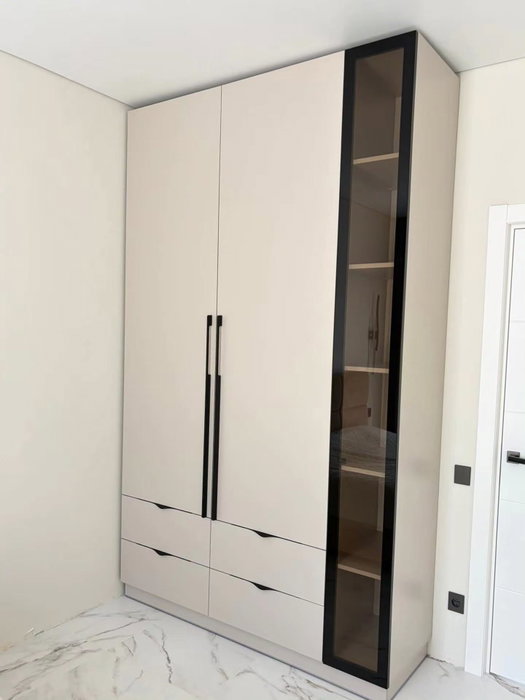
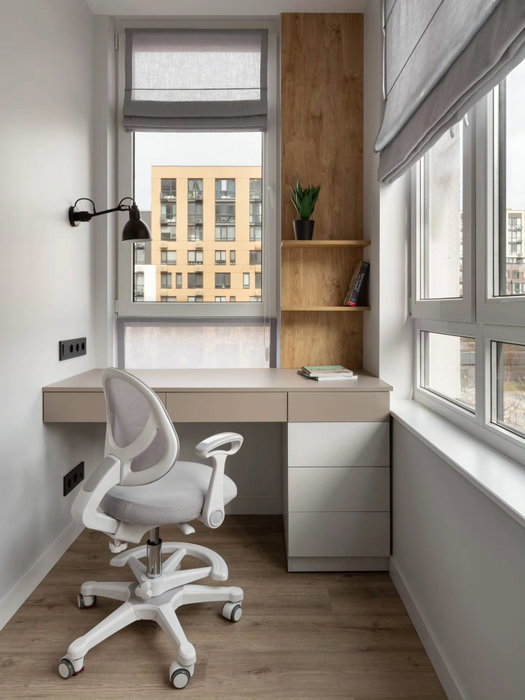
Latest work by SI, ARMARIO
@si.armario
Made-to-measure wardrobes and walk-in wardrobes
Latest posts
What changes when measuring a corner in Dénia
A corner is almost never exactly 90 degrees. It is checked with a set square and diagonal measurements, and we take two widths, two heights and three depths per wall. The skirting board, ceiling edges and any imperfection in the angle are compensated for with an adjustment profile on the front.
This is also the moment to decide the direction of opening, the side where the blind module goes and where the two fronts meet. It is also worth measuring the distance from the corner to the window and to the nearest door frame, because those dimensions determine how far each front can extend. A photo from each wall and another of the corner completes the information we need to plan a corner wardrobe with no surprises on installation day.
Ask us to come and measure up in Dénia
- 01You leave us your name and your area.
- 02We message you on WhatsApp to agree a day.
- 03The measuring visit costs €50 and is free if you place an order.
Corners with hanging clothes: the rail that rotates
Hanging clothes are the hardest thing to organise in a corner wardrobe. A straight rail reaches the corner fine, but the garment at the back is hidden behind the others. One solution is to fit a rail on each side and leave the corner for a wide shelf; another is a rotating rail or a telescopic hanger that slides out to where you can use it.
For suits and long coats, the longer side of the L is the natural choice; the short side takes shelves, drawers and shirts. Dividing the layout this way stops the most-used items from being relegated to the corner and keeps each section easy to read.
What to check in the design before we build
- 01
Before approving an L-shaped wardrobe, check four things. First, that you can reach the back of the corner with the door both closed and open. Second, that the swing of each door is clear and does not hit the other. Third, that the rails are no longer than the top shelf can support. Fourth, that the final height lets you empty the top cupboards without a stool.
- 02
In the configurator you can see the whole unit in plan and elevation and adjust the proportions of each wall. If you have doubts, it is better to sort them out here, because changing the corner once it has been made means remaking pieces that rest on one another.
From the corner to the quote
Enter the measurements of both walls in the configurator and mark nearby windows and doors. The system prepares a design and sends it to us; our team will get back to you with an approximate price within 24 hours of receiving the configuration with measurements, free of charge. A technician then comes to your home to measure up; that visit costs €50 and is not charged if you order the wardrobe.
Once the design is finalised, manufacturing usually takes two to three weeks on average; installation is arranged separately. We work in Dénia and the surrounding area, and you can ask whether a single-body L or two modules joined at the corner suits you better.
Enquiry
Tell us about your project in Dénia
- 1We read your message and look at your photos.
- 2We reply on WhatsApp with a first figure.
- 3We measure up and prepare the final quote. The measuring visit costs €50 if you don't go ahead with the order and is free if you do.
We don't cut a single board until you've approved the design and the price.
Questions
Frequently asked questions about wardrobes in Dénia
After installation: warranty and care for your wardrobe.
Are a corner wardrobe and an L-shaped wardrobe the same thing?
They are practically the same: the corner wardrobe occupies a corner and the L-shaped wardrobe describes its shape. The real difference is whether it is made as one piece or in modules.
How do you reach the back of a corner?
With trays or revolving shelves, rails entering from one side, a diagonal door, or by leaving the corner as a reserve module with direct access.
Can you fit a corner wardrobe in a small bedroom?
Yes, and that is often where it pays off most. We use slim fronts, sliding doors and a compact corner module so as not to take away walking space.
What happens if there is a window in the corner?
The wardrobe is stepped back or stops before the glass. Sometimes the gap is used for a bench, low shelves or a ledge.
Can the doors on both sides be opened at the same time?
Yes, if an upright is left between them or the direction of one door is reversed. This is worked out in the design with the swing drawn in.
Shall we talk about your project?
Send us a photo of the space and some approximate measurements on WhatsApp: we'll give you some initial guidance and arrange the measuring visit.