Made-to-measure open wooden walk-in wardrobes in Dénia
An open wooden walk-in wardrobe keeps your clothes on show and does away with the doors that so often get in the way in a small room. To make it work, you need to decide what is displayed, what is protected in drawers and where you will walk. If you are looking for open wooden walk-in wardrobes in Dénia, here are the principles for dividing the space into modules, keeping things tidy and looking after a wardrobe with no doors or fronts.
Shape your next wardrobe.
Try out the measurements, plan the interior layout and choose your finishes. See your idea take shape and share it with us so we can prepare your quote.
Send us your configuration with your measurements and we'll give you a guide price within 24 hours, free of charge. The measuring visit at your home comes afterwards.
A whole room without doors
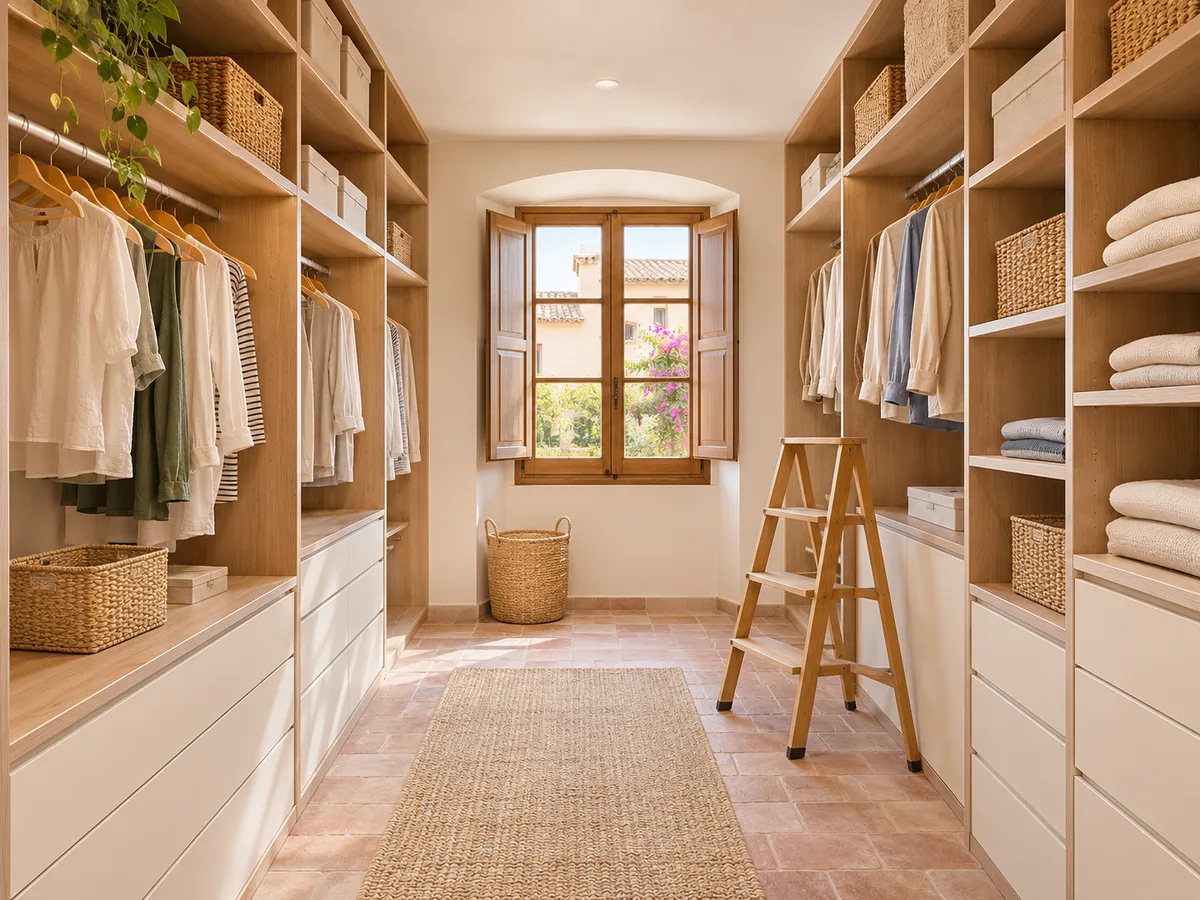
What sets it apart from an open wardrobe is the space itself: an open wooden walk-in wardrobe takes up a whole room, a passage room or several walls, and you walk through it. That lets you think in zones rather than a single wall of storage. A common approach is to dedicate one wall to long hanging, another to shirts and jackets, and keep the shortest wall for shelves and shoes. With no doors to hide anything, every module becomes part of the décor, so the uprights, shelves and rails should all follow the same modular rhythm. Before anything is drawn, we note the free walls, the entrance door and any window that affects where each module can go.
Clear walkways and reach to the upper areas
In a walk-in wardrobe without doors, the walkway comes first. To move comfortably between two facing runs you need a generous aisle, and if two people use it at the same time you will want more. High rails are complemented by a pull-down rail or a pole so you can reach them, and the top shelf is kept for suitcases and seasonal boxes. In an open L-shaped or U-shaped walk-in wardrobe, the corner is the critical point: it is solved with rotating shelves or a rail that changes direction, so that nothing ends up out of reach. Entering the room's measurements into the configurator lets you compare which layout leaves the most space to move.
What to leave on show and what to keep in drawers
The practical rule is to leave on show what you pick up every day and what looks good: folded shirts, jumpers, bags, shoes you wear regularly. Anything that needs protection goes into an open walk-in wardrobe with drawers: underwear, socks, jewellery, belts, scarves. Drawers with uniform wooden fronts keep the unit visually calm and hide the inevitable clutter of small items. A drawer with dividers stops everything getting mixed up, and a shallow one with a soft lining protects watches or glasses. It is also worth including a hanging area with garment covers for suits or dresses that are not worn often, because dust shows more on fine fabrics.
Have you already measured the space?
Send us a photo and the approximate measurements on WhatsApp and we'll give you some initial guidance.
Visible wood, veneer and interior materials
In an open walk-in wardrobe the wood is visible everywhere: edges, shelves, sides and back panel. That makes the material count for more than it does in a closed wardrobe. A natural veneer shows the real grain and ages elegantly, a wood-effect board is more stable and easier to clean, and solid wood is best kept for rails, exposed shelves or small details. The edges deserve attention: edging in the same wood gives the feel of a complete piece, while a contrasting edge picks out the lines of the module. The back panel can be in the same tone or a lighter one to add depth and make the clothes stand out against it.
Shelves, rails and corners with no wasted space
An open wooden walk-in wardrobe makes better use of every module when the heights follow the clothes. For shirts, one rail at mid-height and another above it is enough; for dresses and coats, a taller clear section is left. Shelves for folded clothes, with a modest gap between them, are easier to use than ones set too high, where the piles topple. Corners can be put to good use with corner drawer units, wedge-shaped shelves or a corner rail, avoiding an empty gap that later fills up with loose boxes. Each of these decisions is reflected in the design prepared before anything is made.
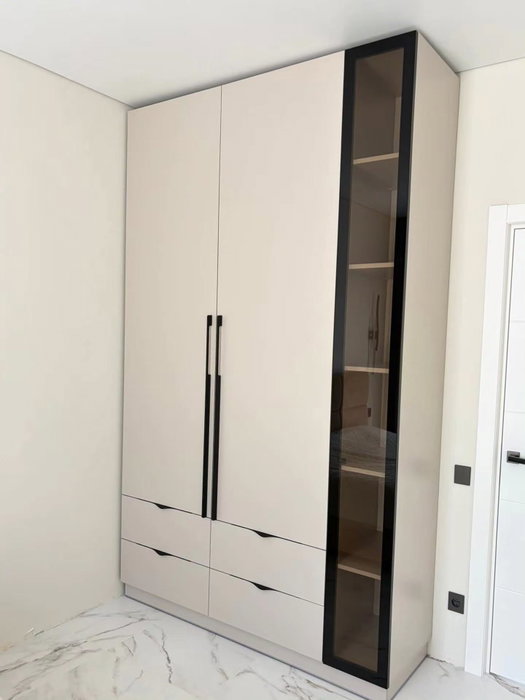
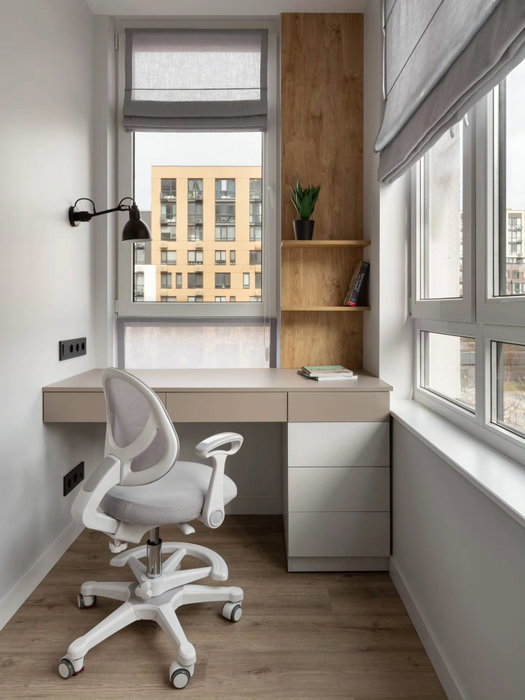
Latest work by SI, ARMARIO
@si.armario
Made-to-measure wardrobes and walk-in wardrobes
Latest posts
Lighting without glare and without heating your clothes
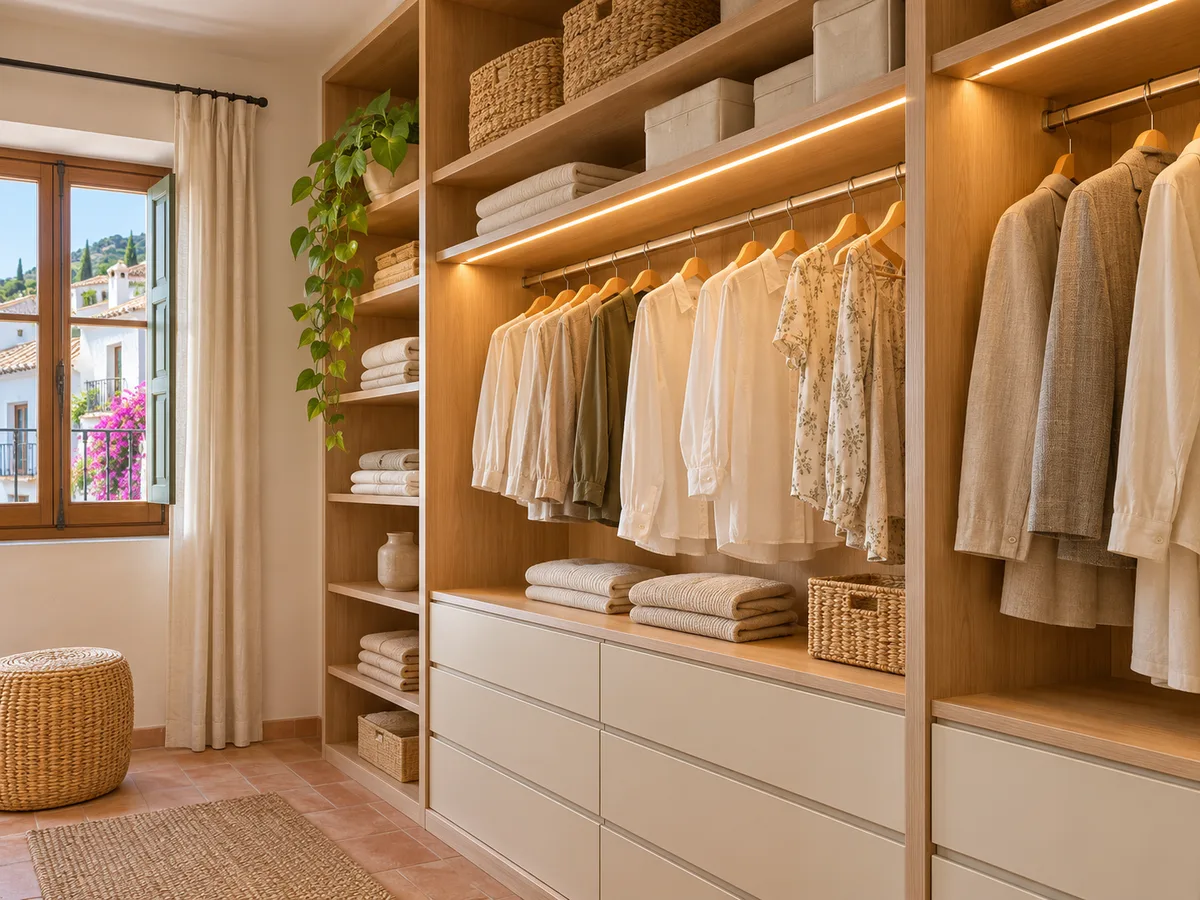
Without doors, the lighting is what defines an open walk-in wardrobe. An LED strip built in under the shelves or into an upright lights the interior without shadows, and a warm, low-power light respects the tone of the wood. Direct spotlights on garments can fade fabrics over time, and powerful spots warm up hanging clothes; indirect, evenly spread light is better. A motion sensor at the entrance saves you fumbling for the switch with your hands full. In a room with a window, we look at making sure the sun does not fall on the clothes for hours, because that fades them more than any spotlight.
Ask us to come and measure up in Dénia
- 01You leave us your name and your area.
- 02We message you on WhatsApp to agree a day.
- 03The measuring visit costs €50 and is free if you place an order.
Dust, ventilation and everyday cleaning
Without fronts, dust settles sooner and shows more. On the plus side, your clothes can breathe, and in a humid climate like the Dénia coast that helps stop fabrics smelling musty. The day-to-day routine is simply running a cloth over the shelves, which rounded edges and smooth finishes make easier. The most exposed areas, such as the high shelves, can be covered with boxes or baskets with lids. If you have pets or often leave the window open, you may value a closed section with doors for delicate items, which combines easily with the open remainder. Vacuuming the shelves when you change over your seasonal clothes is usually enough.
Balancing open surfaces and closed storage
Few people want everything on show, and there is no need. An open wooden walk-in wardrobe combined with a drawer unit, a module with doors for what you would rather not display, or a central chest of drawers gives a clean, practical look. The trick is to balance it: two-thirds open surface and one-third closed works well if you have a lot of clothes. A closed module at one end hides household clothes and blankets and leaves the rest as a showcase. You can try out that mix in the configurator before requesting a quote: add and remove modules until the unit has the balance you are after.
How to order and what happens next
To plan open wooden walk-in wardrobes in Dénia, start with the configurator: you enter the room's measurements, the wall layout and the wood you prefer, and a design is prepared and sent to us for review. Once we receive that configuration with the measurements, the team gives you a guide price within 24 hours at most, at no cost. Then the measuring visit is arranged, which costs €50 if you do not go ahead and is free if you order the walk-in wardrobe. With the design approved, making the modules usually takes two to three weeks on average; installation is arranged separately. If you are torn between two layouts, send both with their measurements: that way they are compared in the same room and you choose with the plan in front of you, rather than by eye.
Enquiry
Tell us about your project in Dénia
- 1We read your message and look at your photos.
- 2We reply on WhatsApp with a first figure.
- 3We measure up and prepare the final quote. The measuring visit costs €50 if you don't go ahead with the order and is free if you do.
We don't cut a single board until you've approved the design and the price.
Questions
Frequently asked questions about wardrobes in Dénia
After installation: warranty and care for your wardrobe.
Is an open walk-in wardrobe the same as an open wooden wardrobe?
An open wardrobe is a piece of furniture against a wall; an open walk-in wardrobe is a room or corner you walk through, with modules on several walls. That is why it is planned around the walkway, not just the shelves.
Is there room for drawers in a walk-in wardrobe without doors?
Yes, and it is highly recommended. An open walk-in wardrobe with drawers keeps small, delicate items stored away, while everyday clothes stay on show. The fronts are usually in the same wood so as not to break up the look of the unit.
How much tidying and cleaning does an open walk-in wardrobe need?
A little more than a closed one: clothes folded fairly regularly and a once-over of the shelves when you change seasons. With boxes up high and drawers for small items, the daily effort is small.
Can I mix two tones of wood in the same walk-in wardrobe?
Yes. You can use a lighter wood on the back panel and another on the sides or drawers. It works best with one dominant tone and differences that look deliberate.
If the bedroom is small, is it worth removing the doors?
It can be, as long as there is enough room to walk. With no door leaves to open, you gain usable space, and an open walk-in wardrobe in an L-shape or along a single wall can solve a small bedroom in Dénia.
Can a module be closed in later?
Yes, if it is planned for in the design. Doors or drawers can be added to a module in the unit when your needs change, as long as the dimensions and fittings allow it.
Shall we talk about your project?
Send us a photo of the space and some approximate measurements on WhatsApp: we'll give you some initial guidance and arrange the measuring visit.